Beelinguapp Language Learning
- 4.1
- Rating
- 5.00M
- Installs
- Free
- Price

 Analysis by App-foxy
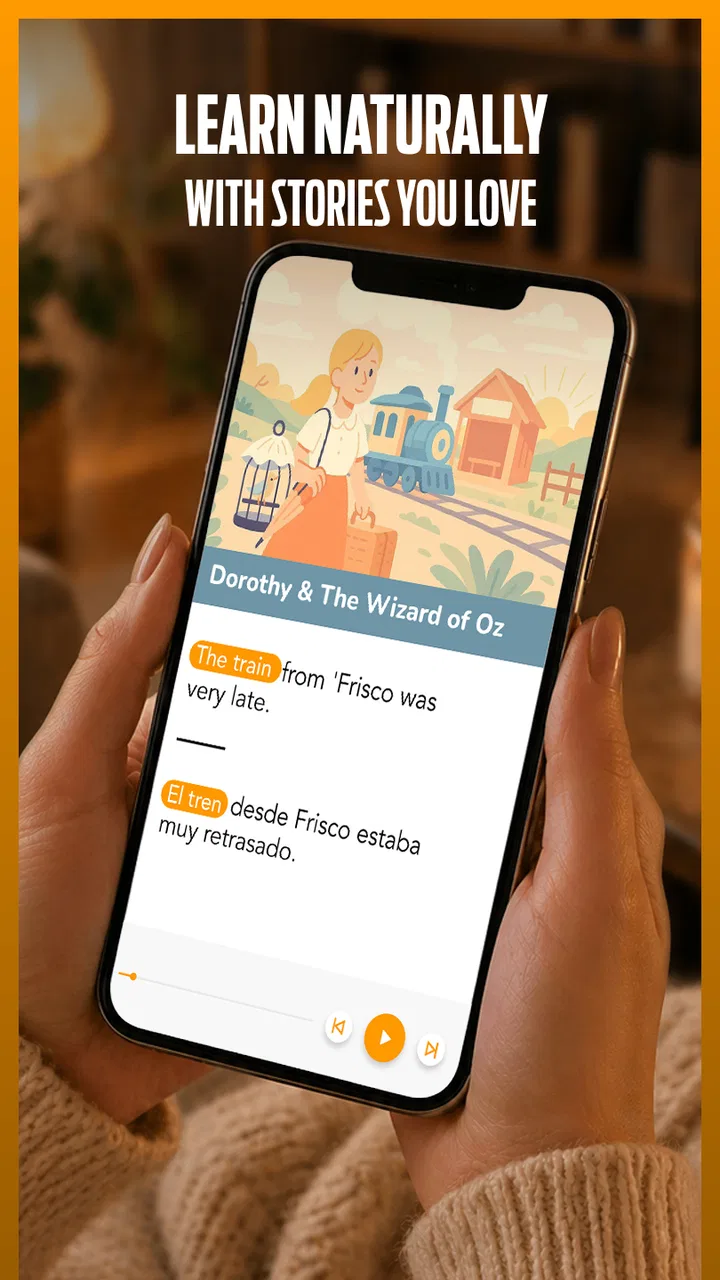
I approached Beelinguapp Language Learning as a reading tool first and a language course second. That distinction matters. Instead of asking you to memorize isolated vocabulary before you can enjoy anything, it places a story, article, or other reading material in front of you with your chosen language alongside a language you already understand. In my experience, that makes the first few sessions feel less like homework and more like guided reading.
The app is aimed at people who want to learn Spanish, French, or another language through bilingual content read by native speakers. It is a free education app from Beelinguapp Languages, available for users aged Everyone, and it runs on Android devices using version 7.0 or later. The current version is 3.285. Its broad audience is reflected in its reach: it has passed 5 million installs, with a 4.1 average from about 82 thousand ratings and roughly 2.7 thousand written reviews.
Choosing a language app by the way you actually learn
Before installing it, I would ask one practical question: do you learn better from a sequence of exercises, or from seeing language used in context? If you enjoy grammar drills, flashcards, streaks, and short quizzes, a conventional course app may give you a clearer daily routine. If you remember phrases more easily when they belong to a story, Beelinguapp has a more convincing reason to be on your phone.
You May Also Like

 Blood Strike: 2.5 Anniversary
Blood Strike’s Loadouts Turn Every Drop Into a Tactical Gamble
A close look at Blood Strike’s custom loadouts: how fast access to signature weapons reshapes its battle royale rhythm, rewards preparation, and narrows the gap between fights.

 Pandora - Music & Podcasts
Pandora’s Music Is Easy to Start, but Harder to Recover
Pandora’s strength is its low-effort path from a seed to a station. Its weak spot is how much confidence it asks you to place in connection, setup, and quiet recovery.

 8 Ball Pool
 Is Built on Rivalries, Rematches, and Routine
A close look at the rivalries, rematches, shared routines, and unanswered safety questions that turn a quick pool match into a persistent mobile community.

 Samsung Music
’s Quiet Strength Is Playing What You Already Own
Its reach comes less from spectacle than from dependable access to a personal library. That simplicity is both the app’s strongest retention engine and its ceiling.

 AccuWeather: Weather Radar
AccuWeather Review: A Quick, Clear Forecast for Everyday Decisions
For everyday plans, the best forecast is the one you can understand quickly. AccuWeather makes rain timing, radar, and local conditions easy to act on, with a few trade-offs.

 Hill Climb Racing
Why Hill Climb Racing Still Turns Crashes Into One More Run
A tiny car, a bumpy hill and one more upgrade: Hill Climb Racing keeps resurfacing because its simple chaos makes every near-miss feel personal.
More From Our News Desk



The bilingual layout is the central decision criterion. You can read the target language while keeping a familiar translation nearby, so an unfamiliar sentence does not automatically stop the session. That is especially useful at beginner and lower-intermediate levels, when a dictionary lookup for every line can destroy your momentum. I found that the translation works best as a safety net rather than as a text to read continuously.
There is also an audio dimension, with native-speaker narration attached to the reading experience. This gives the app a useful middle ground between silent reading and a standalone listening course. I could follow the written sentence, hear its rhythm, and then return to the phrase without having to assemble several separate resources.
My strongest advice is to choose content by difficulty and personal interest, not simply by language. A short story about a subject you already like is more valuable than a longer text you tolerate. The app becomes much more effective when you use it as a repeatable reading habit instead of browsing titles endlessly and waiting for the perfect lesson.
What a productive session looks like
A useful routine is to read once with the translation available, listen again while following the target-language text, and then revisit only the sentences that still feel unclear. On a third pass, hide your dependence on the translation as much as possible and try to explain the general meaning aloud. This turns one piece of content into reading, listening, pronunciation awareness, and recall practice.
I would not translate every word. That is one of the easiest ways to make bilingual reading exhausting. I usually mark the words that appear important to the sentence or that I expect to meet again, while allowing minor details to remain uncertain. The goal is to build tolerance for natural language, not to create a perfect word-for-word version of every paragraph.
Another useful habit is to keep a small personal list outside the app for phrases rather than single words. A phrase such as a greeting, transition, or everyday request carries more practical value than a disconnected noun. Beelinguapp supplies the context that makes those phrases memorable, but you still need to decide which expressions are worth carrying into conversation.
Where the bilingual story format is genuinely strong
The biggest strength is reduced friction. When I encounter an unknown sentence, I do not have to leave the page, open a dictionary, search for a translation, and then reconstruct the original meaning. The parallel text lets me keep moving. That makes the app particularly approachable for learners who have already abandoned reading practice because it felt too slow.
It is also a good fit for learners who dislike artificial examples. A story gives grammar a reason to exist. Verb forms, connectors, descriptions, and conversational patterns appear as part of a situation, which helps me notice how language behaves rather than merely recognizing a rule in isolation.
The native-speaker audio adds another layer that a basic bilingual reader would not provide. I can use the text to understand and the recording to notice pronunciation, pauses, and sentence melody. This is not the same as having a live teacher correct me, but it is a practical way to connect written forms with spoken language.
The app is at its best when you use the translation to keep reading, not to avoid thinking. That sounds like a small distinction, but it changes the learning result. Reading only the familiar side can create the feeling of progress without much exposure to the target language. Reading the target text first, then checking the parallel version, makes the same feature much more useful.
Three less obvious ways I would use it
First, I would use a familiar story as a bridge into a new language. When I already know the basic plot, I can spend more attention on sentence structure and repeated expressions. This is more efficient than beginning with an unfamiliar subject where I must decode both the language and the content.
Second, I would turn the audio into a pronunciation checkpoint. Rather than repeating an entire passage, I would choose one or two sentences, listen closely, pause, and imitate the rhythm. Then I would compare my spoken version with the recording. This is a modest exercise, but it exposes whether I am reading naturally or simply pronouncing each word separately.
Third, I would use the app to prepare for a specific situation. Before traveling, joining a class, or speaking with relatives, I would look for content related to daily life and collect useful sentence patterns. The advantage is not that the app becomes a complete phrasebook; it is that the phrases appear in context, making them easier to adapt instead of recite mechanically.
A fourth tactic is to alternate intensive and extensive reading. On one day, I would study a short passage carefully, replaying audio and checking the parallel text. On another, I would read more freely without stopping often. Intensive work builds accuracy, while extensive reading builds speed. Treating every session like a test can make the app feel heavier than it needs to be.
Where other learning categories may fit better
Beelinguapp should not be mistaken for a complete replacement for every kind of language-learning tool. Its center of gravity is bilingual reading and listening. If your immediate goal is to build a strict beginner curriculum from the alphabet onward, an app organized around sequential lessons may be easier to follow. It may introduce grammar and vocabulary in a more deliberately controlled order.
If speaking is your main priority, a conversation-focused service or a tutor will usually offer something this app cannot: interaction, correction, and the pressure to produce an answer in real time. Beelinguapp can help you hear natural phrasing and rehearse aloud, but it does not turn a reading session into a two-way conversation.
Flashcard-centered tools can also be better when you need deliberate vocabulary recall. Reading helps me recognize words in context, but recognition is not the same as retrieving a word during a conversation. If you repeatedly forget essential vocabulary, pairing Beelinguapp with a separate review system may be more sensible than expecting stories alone to solve the problem.
For grammar-heavy learners, the app may feel under-explained. Seeing many examples can improve intuition, but it does not always answer the question of why a particular form is used. I would choose a grammar reference or structured course alongside it if accuracy in writing or examinations matters more than relaxed exposure.
There is a similar trade-off with content discovery. A large collection can be motivating, but it can also encourage indecision. I recommend choosing one short piece, setting a modest goal, and returning to it before moving on. The app’s value comes from repeated contact with language, not from collecting unfinished readings.
Everyday use: a realistic fifteen-minute habit
Imagine that I have a busy weekday and only a short break after lunch. I open the app, choose a manageable story in my target language, and read the first section without trying to understand every word. I check the parallel text for the sentences that block me, then listen to that section once while following along. Before closing the app, I say two sentences aloud and note one phrase I could use in real life.
That routine is realistic because it does not require a quiet evening or a long study plan. It also avoids a common mistake: treating the app as entertainment that happens to contain another language. The reading remains enjoyable, but I give each session a small learning task. Over several sessions, I can revisit the same passage and notice that fewer translations are necessary.
For a commuter, the audio may be the most convenient part, although the experience is still stronger when the text is available for focused follow-up. For a parent or worker with interrupted time, short readings are easier to resume than a lesson that demands a fixed sequence. For a student, the app can supplement formal study by showing how classroom vocabulary appears in connected language.
What may frustrate you after the first week
The bilingual format can become a crutch. Because the translation is so close at hand, it is tempting to glance at it before giving the target language a chance. I had to impose my own rule: read the original sentence first, make a guess, and only then verify it. Without that discipline, the app can become comfortable reading in your native language with occasional target-language scanning.
It can also feel less satisfying if you want visible progress through a tightly measured syllabus. Story-based learning produces gradual gains in comprehension and familiarity, but those gains are not always as easy to track as completed units or quiz scores. Learners who need a clear ladder of milestones may prefer a structured course as their main tool.
The free price makes trying it easy, but in-app purchases range from $1.99 to $398.00 per item. I would therefore inspect the purchase screen carefully before committing to anything. The app is free to install and use in its basic form, yet the presence of optional purchases means that the most comfortable long-term setup may depend on what content or access you want.
Device compatibility is another practical check. Android users need version 7.0 or later, so an older phone may not be suitable. The Everyone content rating makes it broadly accessible, but suitability for a child still depends on the reading material chosen and the amount of guidance an adult wants to provide.
How much switching is involved?
Moving from a traditional lesson app to Beelinguapp is easy if you are willing to change your definition of a lesson. You will not necessarily open it, complete a fixed drill, and receive the same kind of immediate score. Instead, you choose a text, work through it, and decide how deeply to revisit it. That flexibility is liberating for some learners and vague for others.
The cost of switching is highest for people who rely on reminders and strict progression. You may need to create your own schedule, record phrases yourself, and decide when a reading has been mastered well enough to leave. I see this as a fair trade for learners who want authentic context, but it is still a trade. A tool that gives you freedom also gives you more responsibility.
Switching is easier if you keep your existing tools. I would not delete a flashcard app, grammar reference, or speaking practice service just because I installed this one. Beelinguapp can occupy the reading-and-listening part of a broader routine. In fact, its bilingual passages may make those other tools more meaningful because you encounter vocabulary in connected use before reviewing it deliberately.
On the other hand, if you already read comfortably in your target language and mainly need advanced writing correction or spontaneous conversation, the switch may not justify itself. The app’s most distinctive benefit is strongest before reading becomes effortless. At a high level, you may get more from a tutor, authentic media without parallel translation, or specialized practice aimed at your exact weakness.
Who should install it, and who should skip it?
I recommend it to patient beginners, returning learners, travelers who want practical exposure, and intermediate users who need a gentler way to read more often. It is especially appealing if you enjoy short stories, dislike isolated drills, or find dictionary-heavy reading too disruptive. The combination of parallel text and native-speaker audio gives you a clear starting point without demanding that you understand everything immediately.
I would be more cautious if you need a complete curriculum with guaranteed sequencing, formal grammar explanations, or direct speaking correction. It can support those goals indirectly, but it should not be your only resource. I would also skip it as a primary choice if you know that parallel translations make you stop reading the target language altogether.
The developer, Beelinguapp Languages, has built the experience around a simple idea: meaningful content can carry language practice. I think that idea works, provided you bring a little structure of your own. Choose material at a reachable level, revisit passages, listen actively, and resist translating every line.
My final recommendation is positive, with a clear boundary. Download it if you want a low-pressure way to combine reading and listening, and use the free entry point to see whether bilingual stories match your learning style before considering any purchase. For me, it is more rewarding than a bare reading app and less complete than a full language course. If your goal is to make regular contact with a new language through understandable, repeatable content, this is a worthwhile choice; if your goal is conversation mastery or a tightly guided syllabus, use a different category as your main tool.
FAQs for Beelinguapp Language Learning
01What is Beelinguapp Language Learning, and how does it work?
Beelinguapp is a language-learning app based on reading and listening to stories in two languages at the same time. You choose a target language and read texts while following an audio narration, with your native language displayed alongside it for reference. This format helps learners understand vocabulary and sentence structure through context instead of relying only on isolated word lists or grammar exercises.
02Which languages can I learn with Beelinguapp?
Beelinguapp supports several popular languages, including Spanish, English, German, French, Italian, Portuguese, Russian, Chinese, Japanese, Korean, Arabic, and others, although availability can vary by content and app version. Before downloading, check whether your preferred language pair is supported and whether enough stories are available for your current level. Some languages may have a broader selection of beginner and intermediate material than others.
03Is Beelinguapp suitable for complete beginners?
Yes, Beelinguapp can be useful for beginners because the parallel-text format lets you compare the target language with a familiar language whenever a sentence or word is unclear. The app generally offers accessible stories and audio content, making it less intimidating than reading without assistance. However, beginners may still benefit from learning basic pronunciation and vocabulary separately, since the app is primarily focused on reading and listening practice.
04Does Beelinguapp require a subscription, or can I use it for free?
Beelinguapp offers free content, allowing users to try the reading and listening experience without immediately paying. However, some stories, lessons, features, or learning materials may be restricted to premium users, depending on the platform and current subscription plan. The free version is useful for testing the app, but frequent learners should review the pricing, renewal terms, and premium limitations before subscribing.
05Can Beelinguapp replace a complete language course?
Beelinguapp is best viewed as a supplementary learning tool rather than a complete replacement for a structured language course. It is particularly effective for improving reading comprehension, listening familiarity, vocabulary recognition, and exposure to natural sentence patterns. It may not provide enough detailed grammar instruction, speaking practice, pronunciation feedback, or personalized correction on its own, so combining it with conversation practice and other study methods is recommended.
Pros
- Audiobook-style lessons make language practice feel natural and engaging.
- Parallel texts help learners connect unfamiliar words with context quickly.
- Includes stories
- news
- songs
- and children’s content for varied practice.
- Audio playback supports listening improvement and pronunciation awareness.
- Suitable for short study sessions while commuting or taking breaks.
Cons
- The free catalog is limited compared with the full premium library.
- Some translations may feel less natural or vary in quality by language.
- It offers less structured grammar practice than a traditional language course.
- Advanced learners may find the available content too easy in some languages.
- Offline access and certain learning tools require a premium subscription.

Beelinguapp Language Learning
Gallery